
Ethan Bailey
Information Systems student at CSU San Bernardino focused on enterprise-style security labs, detection engineering, and documenting repeatable incident response workflows.
Approach
How I build and evaluate security projects in a way that mirrors practical blue-team workflows.
I build controlled lab environments to practice detection engineering, monitoring, system hardening, and segmentation in a way that reflects real enterprise operations. My focus is not just on making tools work, but on understanding how telemetry moves through an environment, how visibility is created, and how defenders can use that data to investigate suspicious activity with repeatable workflows.
Core mindset
- —Build segmented environments that reflect enterprise design.
- —Prioritize high-signal telemetry over raw event volume.
- —Document repeatable workflows for investigation and response.
Skills & Tools
Technologies and concepts I use across my lab and detection projects.
Security Operations
- —Splunk Enterprise
- —Google SecOps (Chronicle)
- —Sysmon
- —Zeek
- —Zabbix
- —MITRE ATT&CK mapping
Infrastructure & Administration
- —Proxmox VE
- —OPNsense
- —Tailscale
- —Active Directory
- —Windows Server
- —Linux and Windows VM administration
Engineering & Analysis
- —Detection engineering
- —SPL query development
- —Log pipeline tuning
- —Dashboard development
- —Threat hunting
- —System hardening through GPO
Languages & Scripting
- —PowerShell
- —Python
- —SQL
- —Bash
- —Basic automation and configuration scripting
Selected work
Technical deep-dives into defensive architecture, telemetry, and monitoring.
Architecture • Networking • Access Control
Proxmox • OPNsense • Tailscale
Segmented Security Lab Architecture
A multi-layered environment engineered for Blue Team operations. Features strict network segmentation and Zero Trust remote access across isolated management, internal, and attacker networks.
- —Built isolated lab networks using Proxmox and OPNsense with explicit firewall rules.
- —Integrated Splunk Enterprise for centralized log ingestion and investigation workflows.
- —Enabled secure remote administration through Tailscale and RDP without public-facing exposure.
Detection Engineering • Telemetry • SIEM
Splunk • Sysmon • PowerShell
Detection Engineering Pipeline
Developed custom detections using endpoint and network telemetry to identify suspicious behavior while improving signal quality for triage and investigation.
- —Ingested high-fidelity Sysmon telemetry from Windows endpoints into Splunk.
- —Authored SPL queries to detect MITRE ATT&CK-aligned behavior.
- —Improved visibility into authentication anomalies while reducing noise through telemetry tuning.
Monitoring • Observability • Infrastructure
Zabbix • Proxmox • CPU • Memory
Infrastructure Monitoring with Zabbix
Deployed Zabbix across the lab to centralize health monitoring and create a single dashboard for host and virtual machine performance.
- —Connected each VM to Zabbix for centralized monitoring.
- —Built a dashboard to review CPU and memory usage across the environment.
- —Added Proxmox host graphs to quickly spot infrastructure-wide resource spikes.
Active Directory • Hardening • GPO
Windows Server • CIS Benchmarks
Enterprise AD Hardening & Automation
Implemented a hardened baseline for a Windows Domain environment using Group Policy and Tiered Administrative models.
- —Deployed GPOs to automate security configurations and disable legacy protocols.
- —Configured LAPS for local administrator password management.
- —Validated security posture improvements using automated auditing tools like PingCastle.
Featured visuals
Operational screenshots from the lab environment, including topology, telemetry, and monitoring views.
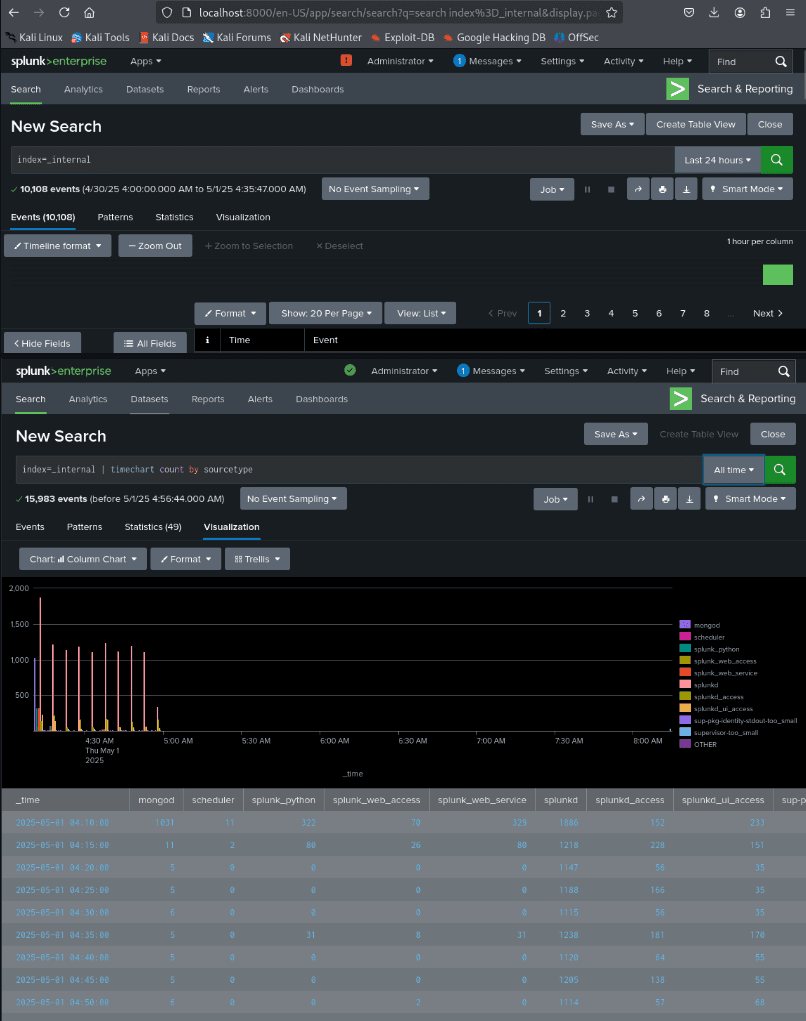
Splunk Detection View
Security telemetry dashboard used to investigate suspicious activity, review authentication patterns, and support detection engineering workflows.
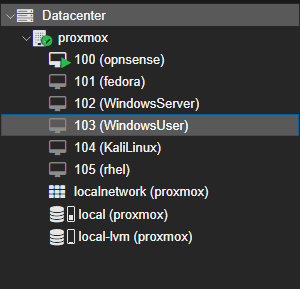
Infrastructure Monitoring View
Dashboard perspective used to review host and virtual machine performance, including CPU and memory usage across the environment.
Lab topology
A defense-in-depth virtual environment engineered on Proxmox VE, utilizing OPNsense for granular network segmentation and Tailscale for Zero Trust administration.
Infrastructure & Services
- —Proxmox VE: Type-1 Hypervisor managing isolated VLAN-style networks and compute resources.
- —OPNsense Gateway: Enforces strict inter-VLAN routing, NAT, and egress filtering to prevent unauthorized C2 communication.
- —Tailscale ZTNA: Provides an encrypted Management Plane for RDP/SSH access without public-facing ports.
- —Windows Server AD: Centralized identity provider for testing GPO-based hardening and authentication anomalies.
- —Splunk Enterprise: Centralized 'Brain' for log ingestion, indexing, and detection engineering.
- —Zeek NSM: Conducting deep packet inspection (DPI) to surface network-level behavioral indicators.
Logical Segmentation
- Management (VLAN 10)Restricted to Proxmox, OPNsense, and Tailscale endpoints.
- Internal / Victim (VLAN 20)Active Directory and Windows endpoints; heavily monitored for telemetry.
- DMZ / Attacker (VLAN 30)Isolated Kali Linux node with no lateral access to Management.
Telemetry Pipeline
Endpoints → Sysmon → Universal Forwarder → OPNsense (TCP 9997) → Splunk Indexer.
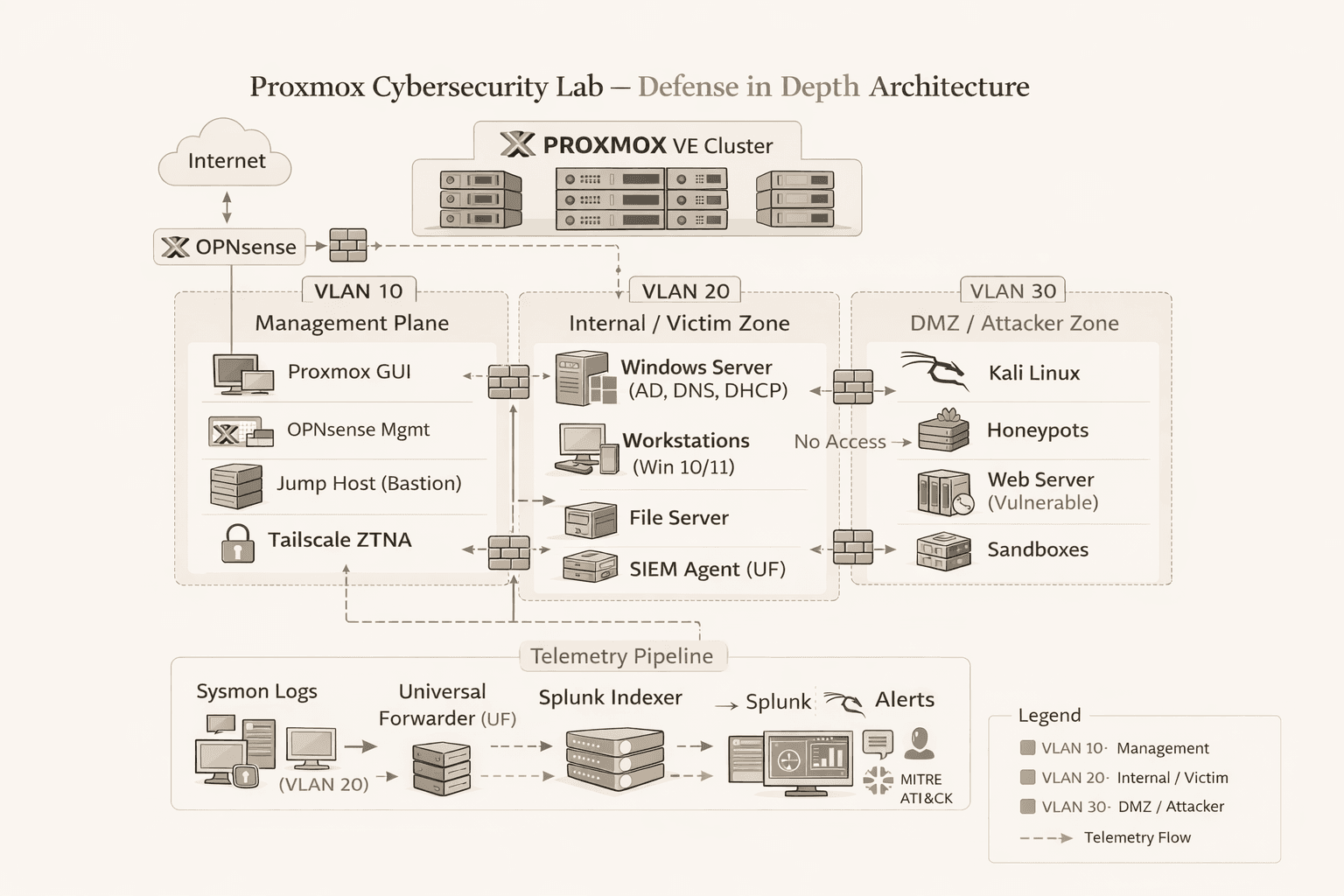
Operational Focus
This environment simulates real-world enterprise segmentation, enabling detection engineering against lateral movement, privilege escalation, and command-and-control behavior within a controlled Blue Team setting.
Credentials
Professional certifications earned in the field.
CompTIA Network+
Earned Jan 2026
CompTIA Security+
Earned July 2025
Google Cybersecurity Professional
Earned Jan 2025